
Imagine being pulled over for a routine stop at a traffic light, expecting a ticket. Instead, you find yourself being arrested by a police officer, setting off a chain reaction that changes your life forever. This is the unfortunate reality for hundreds of Alabamians with outstanding warrants because the law requires that anyone with a warrant be arrested if they encounter law enforcement.
For the Daniel Community Scholars Program, I was paired with fellow Blackburn students JB Foster, Woods Hobbs, Madeline Martin, and Jai Ivy Raines based on our mutual interests in prisons, mass incarceration, and recidivism. While doing research for our project, my team and I learned that Tuscaloosa County alone has over 15,000 outstanding warrants and that a significant portion of these warrants were issued for low-level traffic violations and failures to appear (FTAs) in court. These warrants, in particular, are associated with socioeconomic barriers. Often, when someone receives a municipal arrest warrant, they cannot afford to pay the fine. If someone receives an FTA, they likely could not afford childcare or take time off of work to show up to their court appearance.
As a result, we decided to host a warrant clinic when we learned that warrants worsen these socioeconomic barriers because the conviction creates restrictions on employment, education, and housing opportunities—even voting eligibility. It felt wrong that the price of a minor mistake had such drastic, long-term consequences, so we decided to give people a clean slate.
On the day of the warrant clinic, with the assistance of our partners in the Tuscaloosa Municipal Court, we helped 98 participants resolve 168 warrants. We were also able to get 13 people with felony convictions registered to vote. That means that 98 people no longer have to be held back by their mistakes, will no longer live in fear of the courts, and now have the freedom to pursue education and employment opportunities they previously could not.
The entirety of this experience, from start to finish, was nothing short of transformative. I am a huge proponent of due process, fairness, and justice in the courts, and it was incredibly humbling to have the opportunity to positively impact the Tuscaloosa community through the warrant clinic. One story I reflect on frequently came from a single mother. In our optional survey, she shared that she had 4 children and had no clue how she was going to get her fee paid. The courts, being able to completely resolve the ticket, made her feel like a massive weight had been lifted off of her.
Getting to read and hear people’s unique stories served as a reminder that some circumstances are more complex than others and require empathy and understanding. I truly learned to appreciate the value of a second chance because of how much this work matters to the people that need it. These stories showed me that community impact should be measured in terms of the individual as well. For a while after the clinic, I was upset that we did not have the resources to help every person with a warrant, but knowing that everyone we did help has been given a fresh start is definitely a foundation for solving Tuscaloosa’s larger problem of 15,000 outstanding warrants.
This project also helped develop my understanding of teamwork. Woods, JB, Madeline, Jai Ivy, and I all had different strengths and gifts that made us work together so well. When we ran into a challenge, we pushed forward instead of giving up. When someone had to study for a test instead of work on their part of the project, the others supported them. Our sense of community was the key to the success of the warrant clinic, and we have Blackburn to thank for instilling that value in us.
Participating in this project has benefitted me in more ways than I can name. I am very grateful for the support of the Blackburn Institute staff and the Daniel Foundation for their support throughout the development and implementation of the Tuscaloosa Warrant Clinic. I do believe it is the first step to solving an issue that affects so many Alabamians and will open the door to greater justice in our court system.
About the Author
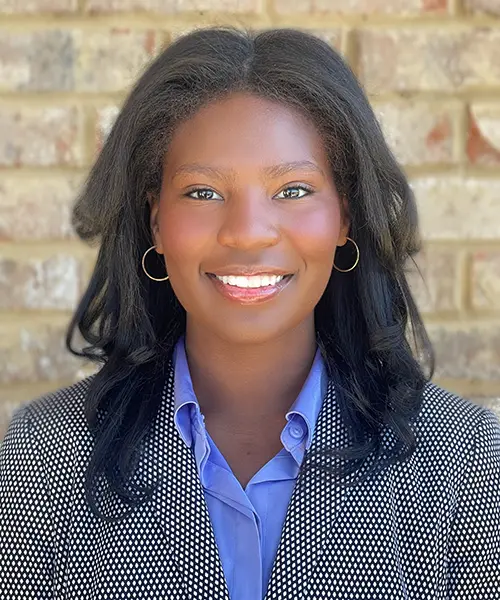
Destiney Crawford is a senior from Pike Road, Alabama. She is double majoring in Political Science and Legal History and minoring in Liberal Arts through the Blount Scholars Program. She aspires to attend law school following graduation to become an appellate attorney, hoping to leverage her passion for constitutional law to shape federal policy and impact outcomes for defendants. On campus, she has found a home within the Capstone Journal of Law & Public Policy, and her sorority, Delta Gamma. Off campus, she has served the Tuscaloosa community by volunteering with the Phoenix House Addiction Recovery Clinic and Tuscaloosa Public Defender. This summer she will be representing the University of Alabama System as a Capitol Scholar interning for Congressman Shomari Figures.