“It’s okay to speak up. It’s okay to share your opinion.”
Royce L. Dickerson looks back on his time at The University of Alabama with fond memories and few regrets. Born in Alabama but raised in her sister state of Georgia, he decided to attend The Capstone for a few reasons.
First, it was family tradition; both his father and uncle had gone to the university, and it was only natural for him and his twin sister Ryann to follow in their footsteps. Second, the list of programs and involvement opportunities were incessantly expanding, and the prospect of what could come from his time outside the classroom was just as enticing as earning the degree while inside it. Third, knowing the history of the South, particularly Alabama, was intriguing to him. Royce knew that his personal growth at UA was contingent on how he interpreted the complexities of the state and its flagship, doing so to determine how to create a better tomorrow for himself and his peers. Nearly a decade after beginning his journey at the university, with a bachelor’s and M.B.A. under his belt, Royce remains a proud graduate and supporter of his alma mater.
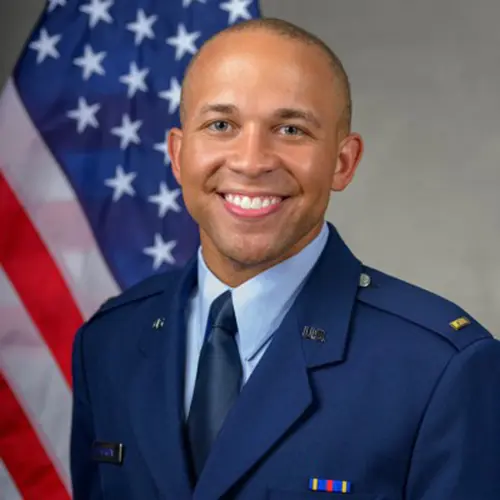
Today, Royce has rounded out his term as a Recent Graduate Advisory Board Member and turned the page to three new titles: Royce L. Dickerson, 2d Lt. in the United States Air Force; Head of Strategic Business Programs at Aflac; and Fellows Internal Vice-Chairperson for the Blackburn Institute. Although he has had a series of roles throughout his life—including but not limited to Student Government Association senator, Capstone Men and Women president, Graduate Student Association president, and Director of Office Management for the White House—Royce will proudly tell anyone and everyone that his roads keep leading back to Blackburn. His relationship with the Institute officially sprouted upon his selection into the Class of 2019, yet he had learned about the organization in the year prior. His good friend Caitlyn McTier (Class of 2018) regularly spoke with Royce about the curriculum within Blackburn, relaying new perspectives gained from travel experiences, teaching moments from DCS projects, and networking opportunities with Fellows and her classmates. He was intrigued by what lay in between the lines of Caitlyn’s recountings; Blackburn pushed students to learn through application and exposure in a way that was unique to its counterparts on campus.
Joining the Blackburn Institute opened doors that Royce had never realized were closed. For one, his student experience allowed him to blend his two focus areas outside the formal lines of academia. A marketing and management major, Royce credits his grandparents for instilling a love of social studies and history within him, something he has carried forward in addition to his professional pursuits. Blackburn laid the foundation for an intentional immersive educational process by combining conversations on policy and the architects behind it, interactions with the citizens affected by industry and legislation, and understanding of the remnants of those who came before us. To Royce, the Blackburn process happening in tandem with Culverhouse courses was crucial to his perception of community and how business could bolster the people it serves. Similarly to how he dug beneath the surface in his conversations with Caitlyn, Royce’s fondest memories can be found in the crevices of Blackburn excursions—breaks in between travel experience sessions, late nights of continued discussion in hotel lobbies, and meals after Symposiums to name a few. Some of the most honest moments among members of the Blackburn community came once the name tags were removed, ties loosened, and heels swapped for slippers. What always remained was a desire to engage more and investigate further.
These moments as a student are what led Royce to run for and be elected as a Recent Graduate Advisory Board member upon his transition into a Blackburn Fellow in 2023. He was thrilled by the prospect of having a say in the future of the Institute, providing more current perspectives on the lives of students and serving as a representative liaison among the different Blackburn community distinctions. His time on the Advisory Board has served to keep Blackburn at the forefront, even when life continually shifts on its axis. Upon graduating with his M.B.A. in 2023, Royce moved to Washington, D.C., where he rose through the ranks in the White House under the Biden Administration. He attributes a significant portion of his success in his professional life to lessons as a Blackburn student, cycling through the four values “like a Rolodex.” Namely, relationships and community must be built with intention, necessary challenges should always be recognized even if unwelcome, and the best ideas can only come through by being challenged. These principles are reinforced continuously both in and outside of the Institute, which he refers to as an “unbreakable link” to the state of Alabama. Royce believes that the beauty of Blackburn lies in the people who make it and being able to see it grow full of differing perspectives and the personal histories they stem from has been nothing short of a privilege.
Of our four values, Royce finds himself most consistently questioning how he can determine, and subsequently answer, his call to action. His self-reflection includes a central follow-up: “What sphere of influence do I sit within, and what resources do I have to deepen my commitment to the matters I care about?” The call to action informs his appreciation of the other three values. A lifetime commitment is much less daunting when everything comes back to bettering one’s community. Bettering the community can only stem from welcoming diverse opinions, particularly if every person’s end goal is to benefit a collective whole rather than a segmented few. Of course, none of this is possible without intergenerational communication and knowledge sharing. Royce acknowledges that the nature of Blackburn values are inextricable from one another; where one is bolstered, the others will follow suit.
Royce ascribes his time in the Blackburn Institute as pivotal to who he is today, as well as who he will continue to become. He learned the significance of active love and deliberate service through his mother and his grandmother, but his new student year showed him that these qualities do not stand in opposition to speaking up for what one believes in. In fact, love and service do not reach their full potential without sacrifice and vulnerability. Blackburn taught him how to greet tension like an old friend, recognizing how this period of discomfort is a requirement to perennial growth.
With all that he has learned in mind, and leaving plenty of open space for the lessons to come, Royce challenges everyone, at every phase of their Blackburn journey, to examine what the Institute means to them. From there, his next question is as simple as it is load-bearing: How can we make it better?